How To Get Recommended in AI Search
How Cal.com became the #1 recommendation in AI search, from bottom-of-funnel content and third-party mentions to YouTube, Reddit, and AI-assisted SEO.
What does it take to be the number one recommendation on an AI search engine?
RankingOnAI.com works across SEO, GEO and AEO, and Cal.com gives us a real example of what that work can look like.
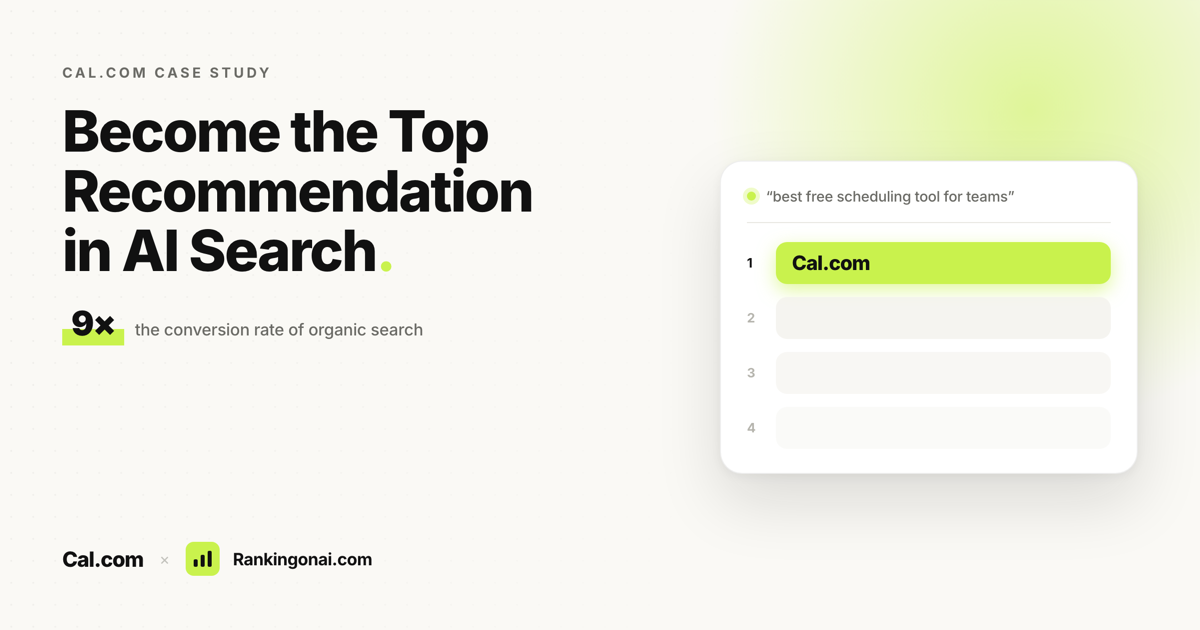
Since we started working with Cal.com as a SaaS Ai Search agency, it has become the top recommendation in its category across the major AI assistants. Ask ChatGPT, Claude or Perplexity for the best free calendar scheduling tool and Cal.com comes back first across the searches we track.
The impact has also started showing up further down the funnel. Ryan, who runs go-to-market at Cal.com, told us that roughly one in three meetings coming through the sales motion now comes from AI search. That share has roughly tripled since we started working together.
So what did we actually change?
This is a deep dive into the work behind that result: how we approached Cal.com’s AI visibility, where we focused our efforts, what didn't work, and what helped Cal.com reach the top of AI search.
What does “number one” mean in AI search?
AI search results aren't fixed in the same way a Google ranking is. The answer can change depending on the prompt, the platform, and when you run the search.
That makes AI visibility harder to measure than a traditional search ranking. A screenshot tells you what an assistant said at one point in time. It doesn't tell you whether the same result keeps appearing across the searches that matter.
For Cal.com, we track a set of commercial prompts across the major AI assistants and look at how consistently the brand appears, where it appears, and which sources are being used to support the recommendation.
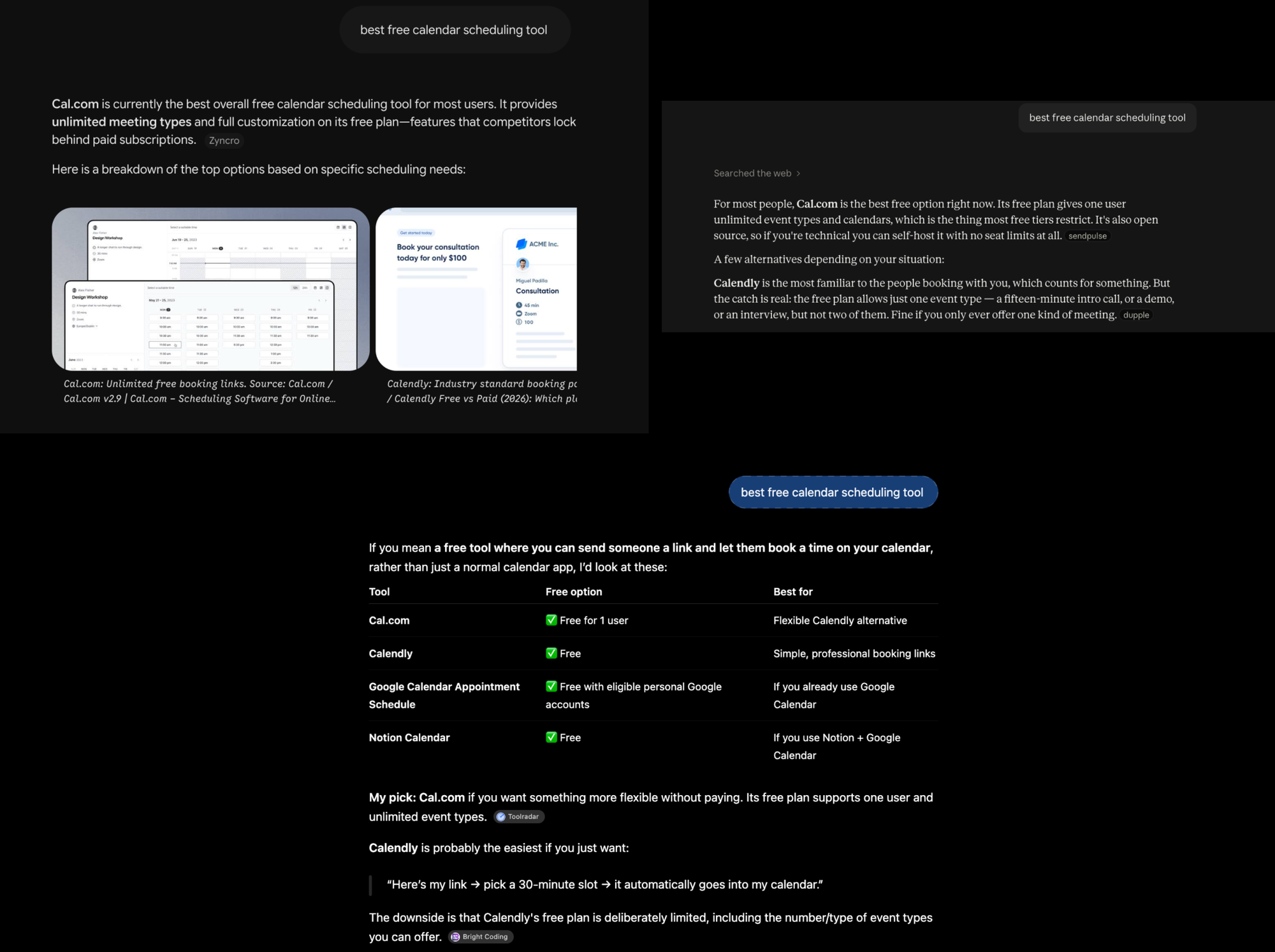
Once we started looking at the sources behind AI answers, we could see what information was actually feeding into the recommendations and where there were opportunities to influence them.
The recommendations are not a black box.
When ChatGPT gives you an answer, you can see the sources it used. Open the More actions menu and select View sources.
We started doing this regularly while working on Cal.com. One answer about scheduling tools had around 50 sources behind it.
Some were predictable. Cal.com's own pricing page was cited for details about its free plan. Others were more interesting. Competitor websites showed up too, including pages that compared different scheduling tools. The model was using those pages to build its understanding of the category, even when the site itself wasn't the final recommendation.
And then there were the odd ones.
In one run, a listicle about the best calendar scheduling software for tarot readers appeared in the sources.
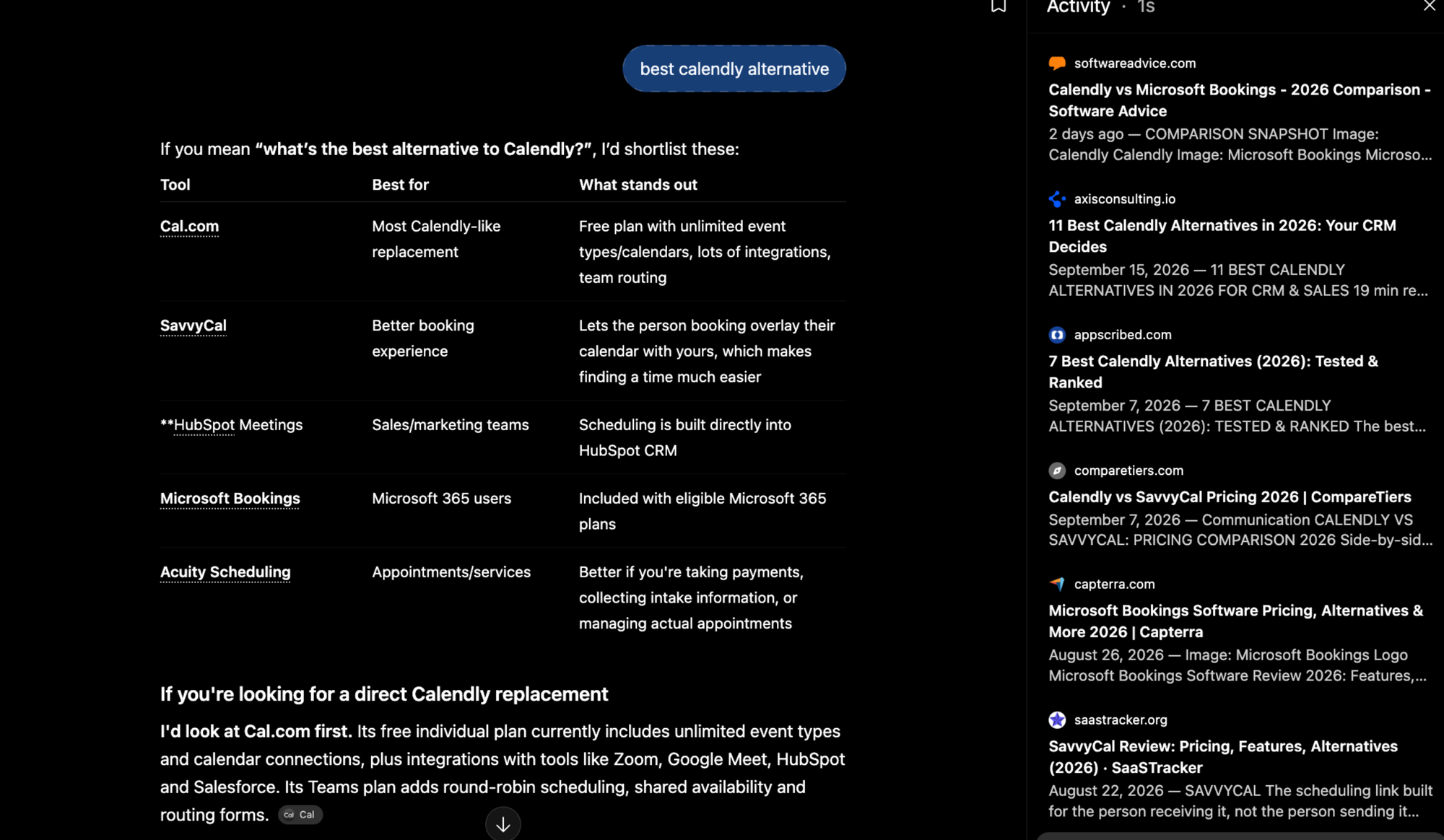
That tells you something important about how AI search works. The sources behind a recommendation aren't limited to the websites you'd expect to matter. The model is pulling together information from across the web, including pages targeting very specific searches and audiences.
So instead of guessing what ChatGPT might be looking at, we started looking at the sources ourselves.
That became a big part of the Cal.com strategy: find the sources influencing the answers, understand why they are being used, and build the kind of presence that gives AI search more reasons to recommend Cal.com.
AEO VS SEO
There’s a lot of debate about whether AI search is a completely new discipline or just SEO under a different name.
Our experience with Cal.com has made the answer fairly straightforward: a lot of the fundamentals are the same.
You still need to be visible in the places people are looking. You still need information about your company to be clear, accurate and easy to understand. And you still need other sites to mention and link to you.
What has changed is where some of that work happens and what seems to carry more weight.
For us, three things stood out:
- Structured data isn't the main lever: Schema and FAQ markup still have their place, but they aren't where we'd put most of the effort if the goal is to influence AI recommendations.
- Third-party mentions matter more: AI search doesn't just learn about a company from its own website. It pulls information from comparison pages, reviews, directories, industry sites and other places where a company is mentioned.
- The type of content matters more: Getting traffic to a page isn't the same thing as getting a buyer to consider your product. We wanted to focus our content on the searches where someone is actually choosing between products.
We stopped trying to cover the whole calendar scheduling category and started concentrating much more heavily on bottom-of-funnel searches: comparisons, alternatives and tightly defined “best” searches where the person already knows what they need and is deciding which product to use.
The content strategy: bottom of funnel first
We stopped putting much effort into generic informational content for Cal.com and shifted the budget towards comparisons and tightly scoped listicles.
That is probably the biggest strategic decision we made on the account.
The reason is fairly straightforward. Someone searching “what is a calendar scheduling tool” is still very early in the buying process. Someone searching “Cal.com vs Calendly” or “best calendar scheduling tool for [specific use case]” is much closer to choosing a product.
We wanted more of the second type of search.
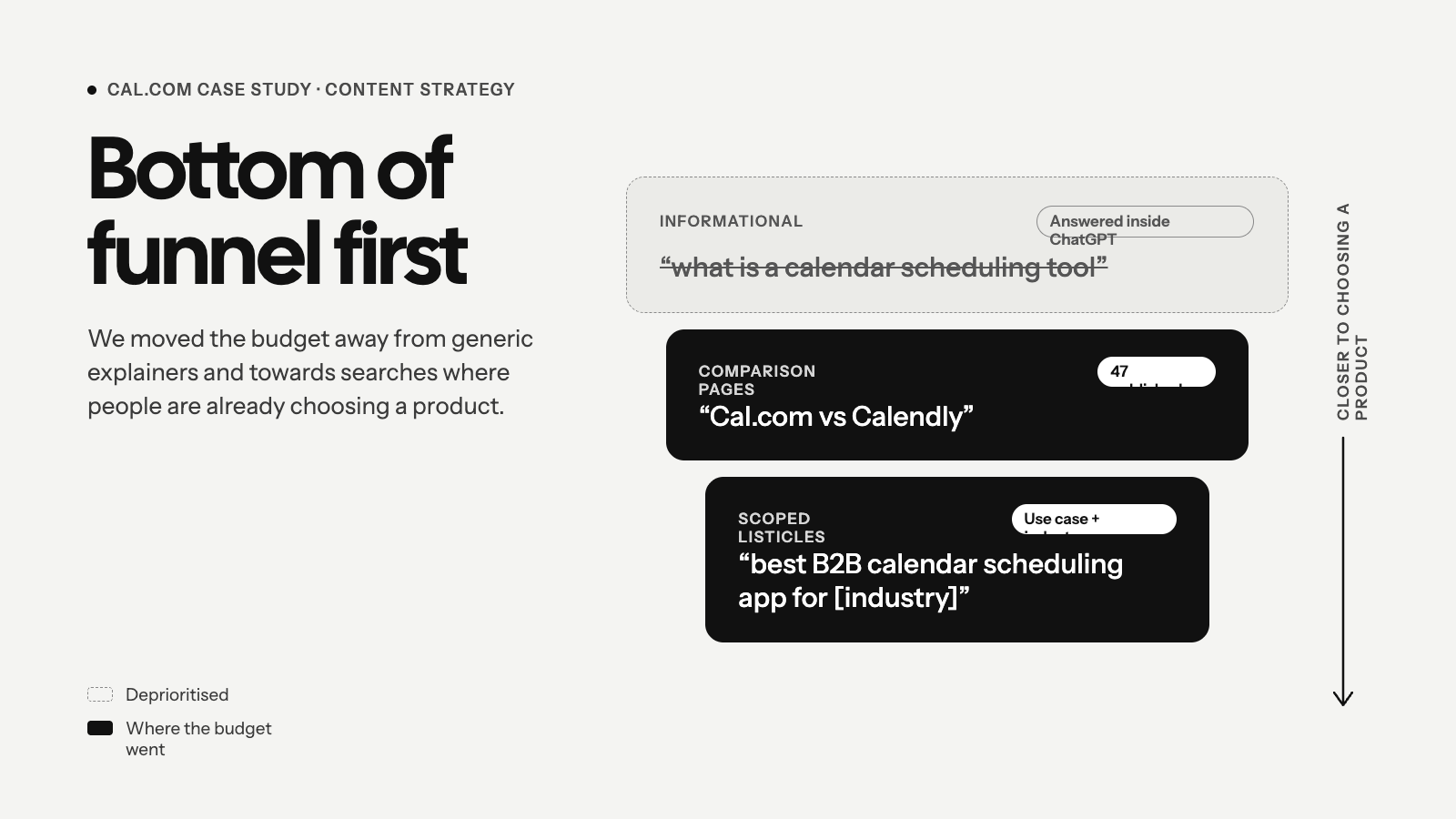
Comparison pages:
A post on X that reverse engineered Cal.com's AI visibility counted 47 comparison posts on the site. That count is accurate, and the author was right to identify comparison content as a major part of the strategy.
We have pages comparing Cal.com with SavvyCal, Calendly and other named competitors.
The important part is how those pages are written. They need to give the reader enough information to make an actual decision. That means covering the differences properly and being willing to say where the competitor is a better fit.
A comparison that gives Cal.com the win on every single point doesn't help anyone. It reads like marketing copy, and there is little reason for a model to treat it as a useful source.
Scoped listicles:
The X post missed another large part of the strategy: how much “best of” content we publish.
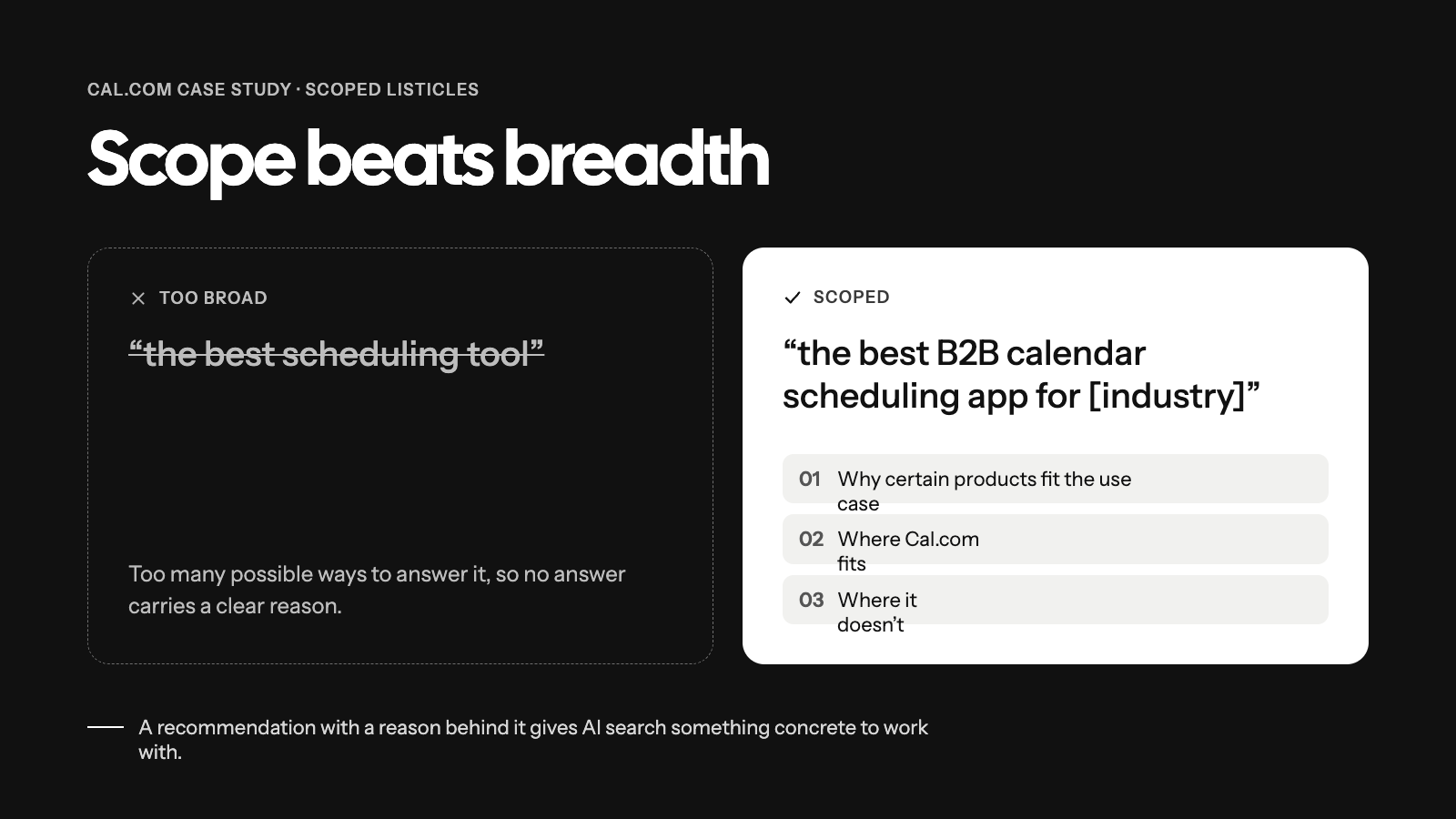
We don't spend much time trying to rank for something as broad as “the best scheduling tool.” There are too many possible ways to answer that question.
Instead, we go after specific use cases and industries:
the best B2B calendar scheduling app for [industry]
That gives us a much more useful page to build. We can explain why certain products fit that use case, where Cal.com fits, and where it doesn't.
This kind of content also gives AI search something concrete to work with. The recommendation has a reason behind it.
Why we dropped informational content
Generic informational content used to be a reliable way to bring people into the site. Someone searches “what is a calendar scheduling tool,” reads the explanation, clicks around the site and eventually signs up.
A lot of that journey now happens inside the search result.
ChatGPT can explain the category. The user may never need to visit the page.
And even when they do, someone searching a basic definition isn't necessarily looking for a scheduling product yet.
So we stopped spending much of the content budget on that part of the funnel. The focus went towards searches where someone is already comparing products or looking for a recommendation.
That is where we saw the strongest opportunity to get Cal.com into the conversation.
Where we place content outside the client's own site
Some of the most useful work happens away from the client's domain.
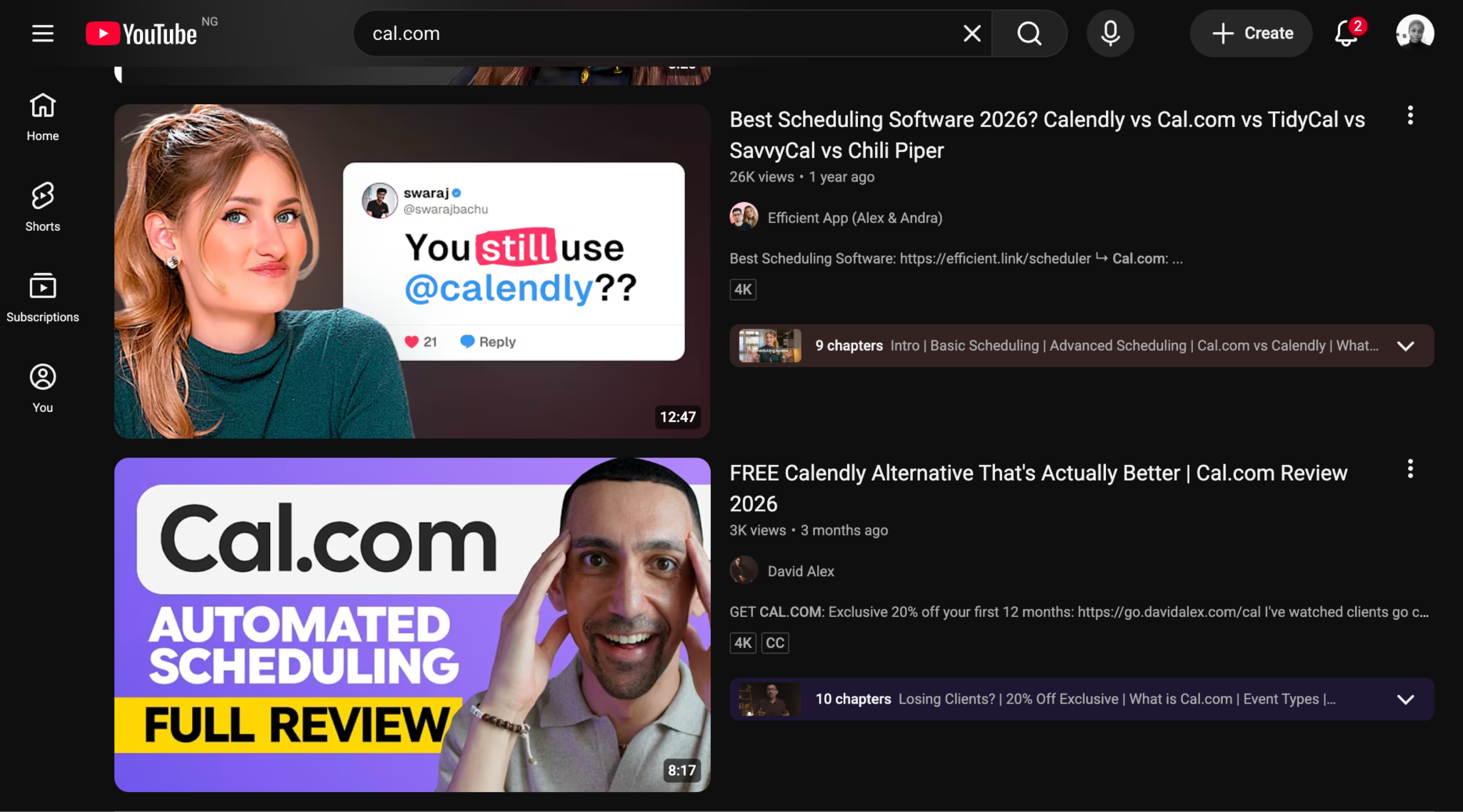
For Cal.com, two areas have been particularly useful: YouTube and existing listicles that already rank for relevant searches.
Reddit, and why we moved away from it
Reddit was everywhere in AI search through late 2025 and early 2026. It was being cited heavily in ChatGPT, helped in part by the OpenAI data partnership.
That created an obvious problem. Once everyone noticed, everyone started trying to manufacture mentions.
The platform responded with tighter moderation, comment rate limits and more archived threads. The opportunity we were seeing earlier became much harder to scale.
We still monitor Reddit. If there is a thread getting traction around a relevant use case, we'll get involved. But we don't treat Reddit as a major part of the strategy anymore.
That is fairly normal in SEO. A tactic works, people pile into it, the platform changes something, and the economics change with it.
YouTube is where we'd spend now
YouTube is a different story.
Ahrefs analysed 75,000 brands and found a strong correlation between YouTube brand mentions and AI visibility. They counted a mention when a brand appeared in a video's title, description or transcript. YouTube had the strongest correlation they measured, at roughly 0.74, compared with 0.66 for branded web mentions and 0.22 for backlinks. The study covered ChatGPT, Google AI Mode and AI Overviews.
That's enough for us to take YouTube seriously.
We've started running creator partnerships, commissioning videos that actually cover the product, and treating those videos as part of the search strategy rather than a separate brand awareness exercise.
Getting into listicles that already rank
We did this early with Cal.com and have kept doing it.
We worked to get Cal.com included in existing roundups of scheduling tools, including a HubSpot article, and have continued that outreach since.
The appeal is pretty simple. The page already ranks. It already has authority. It may already be getting read by the AI systems we're trying to influence.
Getting Cal.com mentioned on that page can therefore do more than publishing another article on Cal.com's own site.
That doesn't make the client's website irrelevant. It means we're dealing with a much bigger web than the client's website.
The idea that you can win AI search by tweaking a landing page for ChatGPT misses a large part of what is happening. The landing page is one source. The model can look at dozens of others.
So we want Cal.com mentioned in the places those models are already finding and using.
LinkedIn is the next channel we're paying more attention to. We expect it to become a bigger part of the mix, particularly as AI search continues to pull information from public professional content.
Why publishing a thousand AI articles can hurt more than it helps
There is a big difference between using AI to help produce content and using it to fill a website.
We use AI much more in production now than we did a year ago. But there is still a lot of work around every article: deciding what deserves a page, checking whether we've already covered the topic, making sure the page has a clear purpose, linking it properly, and having someone actually review what was written.
The other approach is easy to spot. Generate hundreds of articles, publish them automatically and move on to the next batch.
We see sites doing this all the time. The pages often have little connection to the company's actual expertise, overlap with each other, have no clear author, and aren't connected properly to the rest of the site. A large number never get meaningful organic visibility.
There are a few problems with that approach:
Author information still matters
A page with a real author, a useful bio and evidence of relevant experience gives readers more information about who is behind the content.
That becomes particularly important when a site is publishing at scale. If hundreds of articles appear with no author or editorial ownership, there is very little for a reader to use to assess where the information came from.
We don't solve that by adding a fake author bio to an AI article. The person attached to the content needs to have a real connection to the subject.
Publishing similar pages creates its own problem
Take a keyword like “best calendar scheduling tool for med spas.”
If you publish five pages targeting essentially the same search, you've created five URLs competing for the same opportunity.
We'd rather have one strong page with a clear primary keyword.
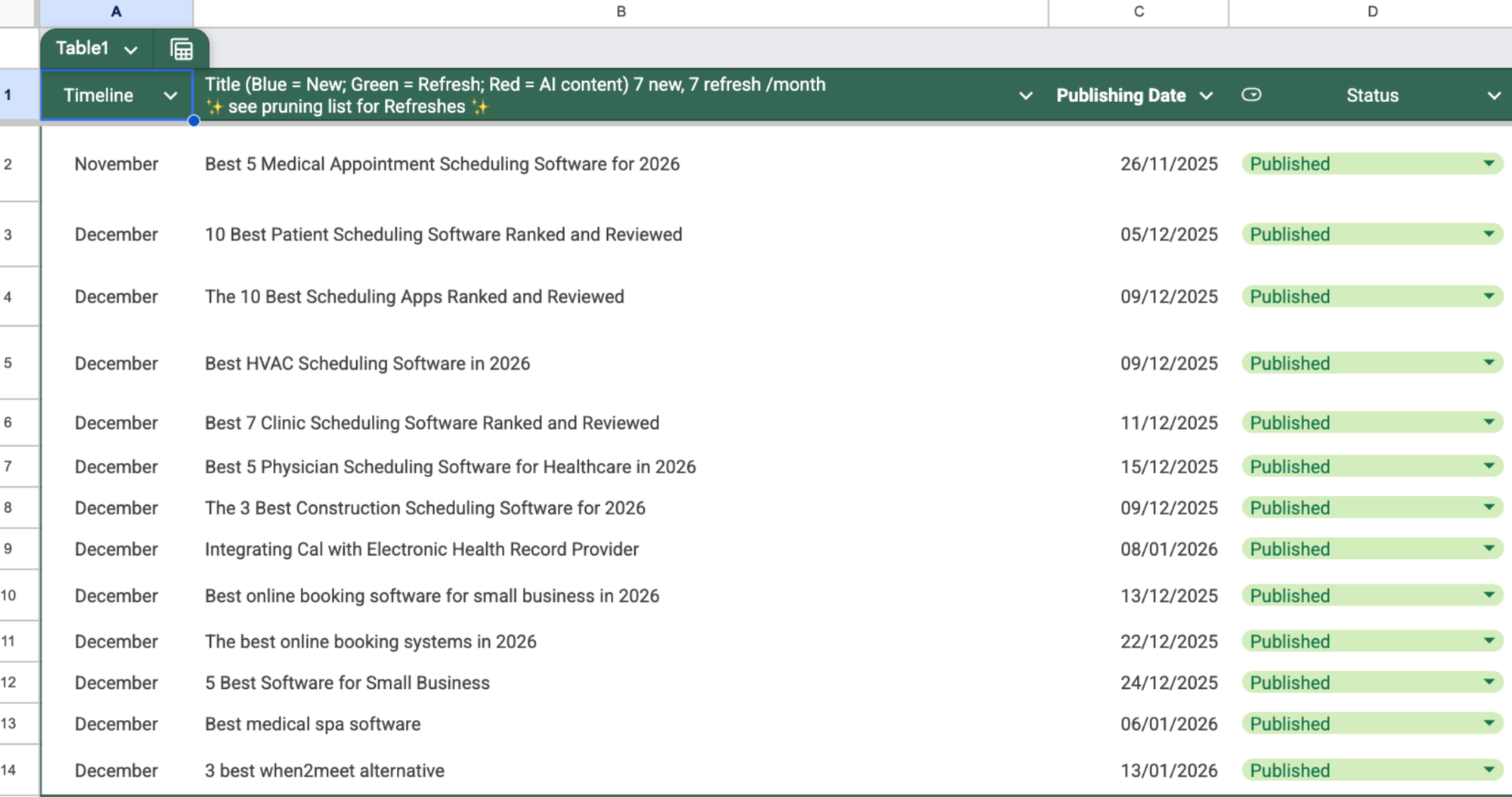
This is why we keep a content calendar with the title, URL, primary keyword, owner and publish date. Before we commission another article, we check what we've already published.
It's not complicated. It just stops the team from accidentally writing the same article five times.
More pages also means more pages to manage
Every page you publish needs to earn its place on the site.
It needs links from other relevant pages. It needs to fit into the site's structure. It needs to be maintained. And if it isn't doing anything for the business, eventually you're left with a large collection of URLs that nobody really needs.
For Cal.com, we pay particular attention to internal linking because the strongest pages on the site can pass authority to pages that matter commercially.
Sometimes the fix is very simple. If an article is performing well, give it a prominent internal link from another strong page. If a page matters to the business, don't leave it sitting three levels deep with no meaningful links pointing to it.
More content doesn't mean more chances to rank
This is probably the biggest misconception we've seen with AI-assisted publishing.
A thousand articles don't give you a thousand independent lottery tickets.
If most of those articles are targeting weak or overlapping topics, aren't internally linked properly and aren't good enough to attract links or mentions, you've mostly created a thousand more URLs to maintain.
Where we have landed on AI-assisted content
We use AI extensively in the production process now. Research, outlining, first drafts, restructuring, editing, there are plenty of places where it saves time.
But we don't let the volume of content determine the strategy.
Someone still needs to decide what gets published, what keyword it owns, how it fits with the rest of the site, where it should link, and whether the final piece is actually worth reading.
The content prune, and what it did for Cal.com
We deleted a large number of pages from the Cal.com site, and traffic to the remaining pages rose afterwards without us changing a word on any of them.
The rule we apply is narrow and easy to audit. A page goes if it has zero clicks, zero impressions, and is not indexed. Those three conditions together mean the page is doing nothing for you and is costing you crawl budget.
Running takes an afternoon. Open Google Search Console, go to the Pages report, and look at what is indexed versus what is excluded. If a site has a large volume of AI generated content, you can usually predict what you will find before you look: most of it never made it into the index.
The cause varies. Thin authority signals, too much published too fast, cannibalization across the set, a domain that has not earned the trust to support that volume. The remedy does not vary much.
The instinct to keep everything because deleting feels like destroying value is the wrong instinct here. Those pages are not neutral. They are taking crawl attention away from pages that could earn.
Parasite SEO, including the move we'd make with a $100 budget
If your own domain has little authority, publishing another article on it isn't always the fastest way to get visibility.
That's where third-party platforms can help. You're putting useful information about your product somewhere that already has an established audience, search presence or both.
Cal.com is an interesting example because the company has built enough authority that even its public booking pages can rank independently. Search for someone's name and their Cal.com booking page can sometimes appear on the first page.
You don't need a domain that is strong to use the same principle. You just need to find places where your product can be discussed naturally and where the page has a chance of being discovered.
What we'd do with $100
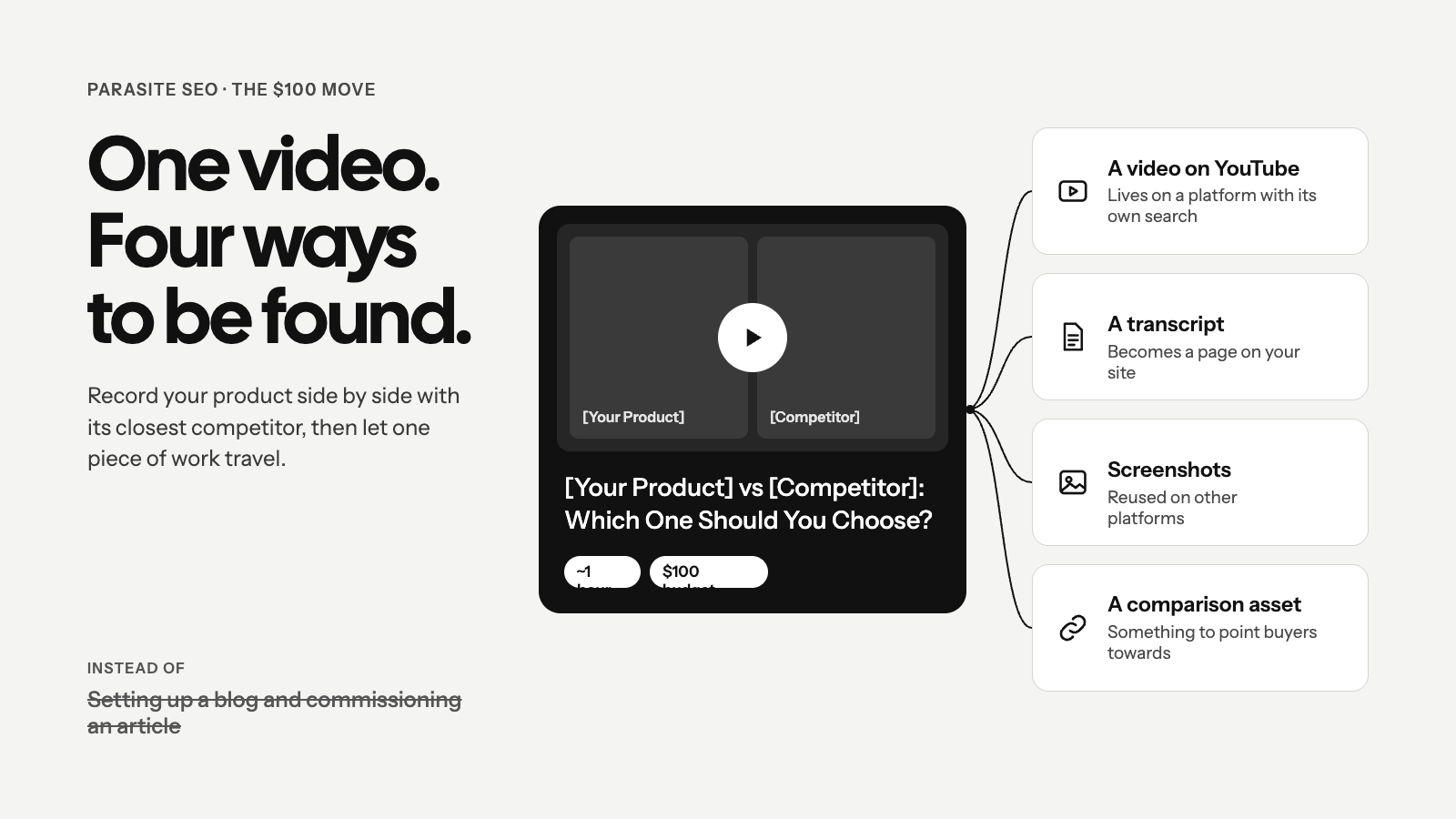
If you gave us $100 and a new SaaS company with almost no search presence, we wouldn't spend it setting up a blog and commissioning an article.
We'd record a video.
Open Loom or another screen recorder. Take your product and the closest competitor. Walk through the two products side by side. Show the differences. Explain who each one is for. Answer the questions a potential buyer would actually ask.
Then publish it as something like:
[Your Product] vs [Competitor]: Which One Should You Choose?
Now you have a video that can live on YouTube, a transcript that can become a page on your site, screenshots that can be reused elsewhere, and a piece of comparison content you can point people towards.
The whole thing can take an hour.
That's a much better use of a tiny budget than spending weeks building a publishing machine before you have anything worth publishing.
We use this approach with clients now because it gives one piece of work several ways to be discovered.
Track revenue per article, then stop trying to track everything
There are two things we care about when measuring SEO.
First, we want to know which pages are actually producing business. Second, we accept that we will never see the full impact of AI search in analytics.
Track the revenue you can see
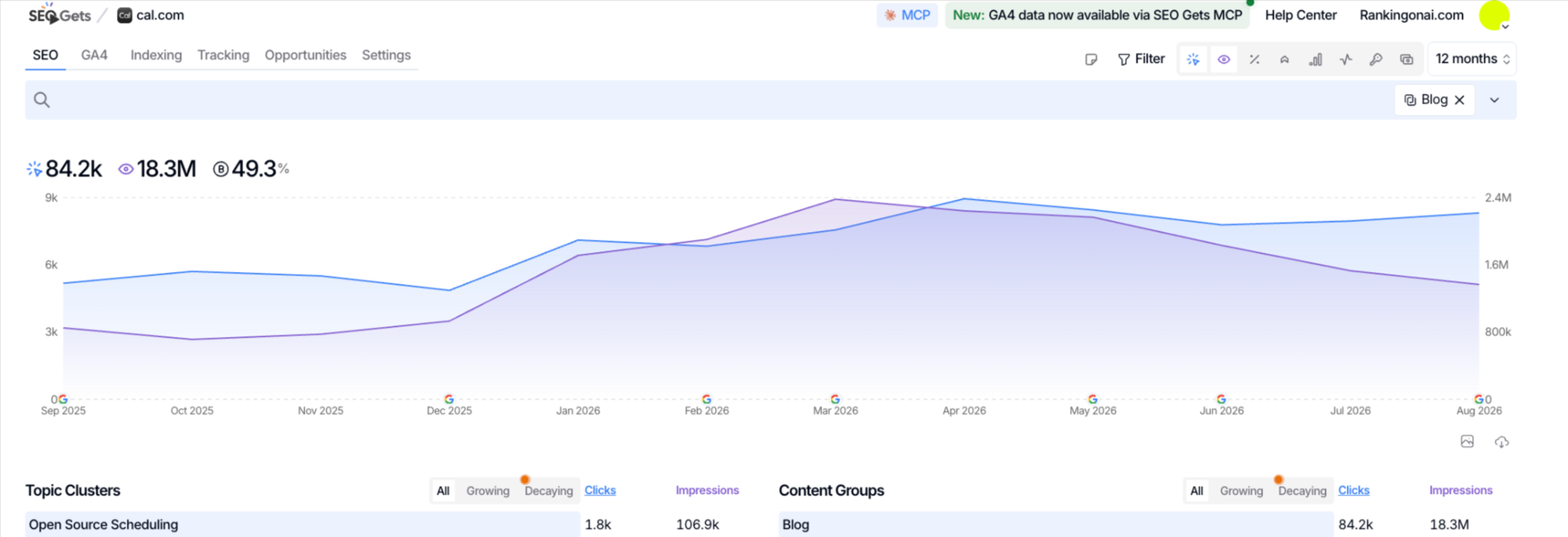
We spend a lot of time in clients' analytics looking at which pages are driving signups, demos, trials and purchases.
If one article generated 30 signups last month, or contributed $30,000 in revenue, that matters. It tells you something useful about where the content budget is working.
The setup isn't particularly exciting. Define the key events in GA4, make sure the tracking fires properly, and connect those events back to the pages that contributed to them.
The payoff is in what happens afterwards.
Instead of saying “organic generated 500 demos,” you can see which pages are actually contributing to those demos. That changes what you publish next and where you put the budget.
Those are the numbers we bring into client meetings: what happened last month, what generated revenue, and which pages contributed to it.
Accept what you can't see
AI search is harder to measure.
Someone can see Cal.com recommended in ChatGPT, close the window, and type cal.com into Google two days later. That visit will probably show up as branded search. Someone else might go directly to the site a week later. There may be no obvious connection between the eventual visit and the AI answer that introduced them to the company.
AI answers also don't always contain a link, and even when they do, the person may never click it.
So the analytics will always show only part of the picture.
That doesn't mean we ignore measurement. It means we don't wait for perfect attribution before making decisions.
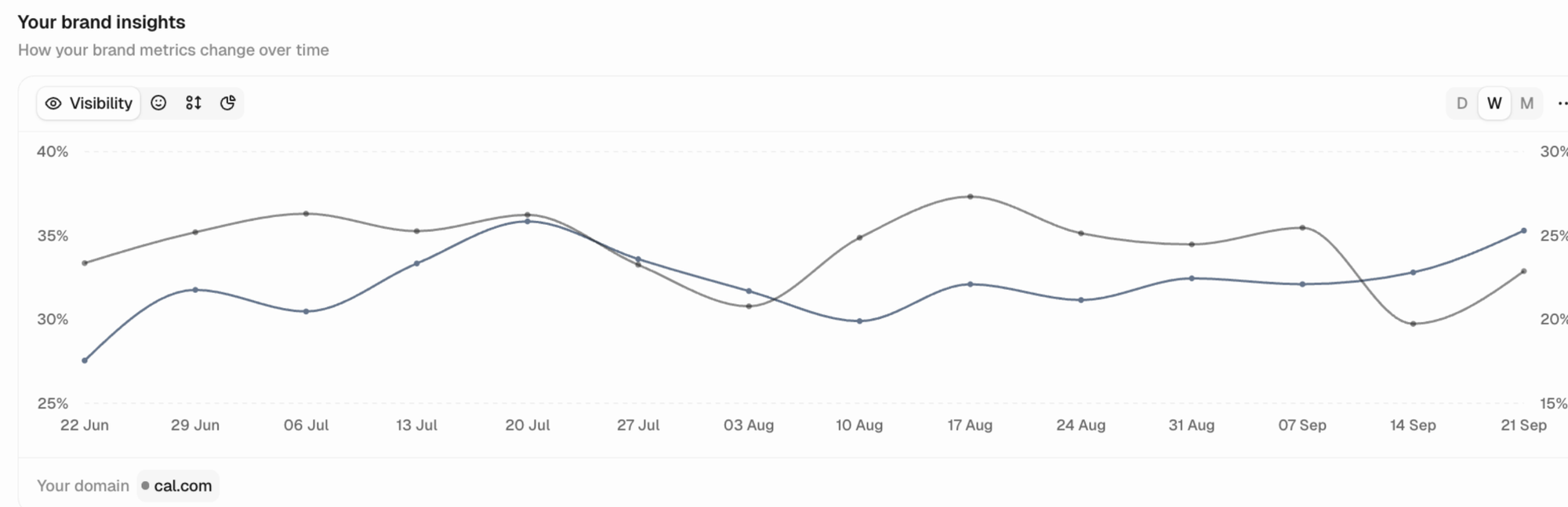
If the same prompts repeatedly recommend your product, your brand mentions are growing across relevant sources, and the pages you're investing in are generating revenue, you have enough information to keep going.
You don't need to know exactly which AI answer influenced every eventual customer.
Track what you can. Use the rest of the evidence to make decisions. Then get back to doing the work.
Who should own AI visibility inside the company
For a B2B company, keep it next to sales. It is lead generation, and it works dramatically better when the people writing the content can talk to the people taking the calls.
Where there is an existing SEO team, they will usually carry it, because they have the content and outreach capability already. Where there is not, it lands with general marketing. But the pattern we now see working best is a direct line into the sales team, for one reason: sales calls are the best keyword research available.
We can ask a sales team directly why a deal closed, what the prospect said they needed the product for, and what language they used to describe the problem. That is better input than any keyword tool, and it lets us move fast. If a feature question starts coming up on every call this month, we can have a page live about it inside a week, rather than discovering the trend in search data a quarter later.
It also changes what counts as a viable target. We can go extremely long tail, into terminology with almost no measurable search volume, because we are optimising for citation in an answer rather than for a volume threshold in a keyword tool.
There is a loss case that sales teams recognise immediately. A prospect is already in conversation with you, doing their own diligence, and they ask Claude or ChatGPT how you compare. If the model says a competitor is stronger, or says it has never heard of you, the deal is usually gone, and the rep never learns why. A lot of the demand we see now comes from teams who simply want to be present and accurately described at that moment.

Starting from zero: the three things we would do first
If you have no content and no rankings, these three come before anything else, in this order.
- Fix the technical baseline. Make sure the site is crawlable, that any client side rendering is resolved so crawlers see real content, that a sitemap exists and is submitted, and that Search Console and Google Analytics are connected. None of this is glamorous and all of it is a prerequisite.
- Create an outside presence. One product walkthrough and one comparison video, following the approach above. This is the highest return per hour available to a small team right now.
- Be consistent, and give it three months. Publish deliberately, keep the calendar clean, and let it compound. Specifically, do not fill that waiting period by generating a thousand pages, because that will undo the first two steps.
In year one, chase your achievable wins rather than the most ambitious content you can imagine. A piece that takes six weeks to produce and six months to rank is very hard to defend internally when nothing else is working yet. Get the first results, prove the channel, then invest in the harder work.
This channel is close to winner take all
Unlike social, AI recommendation is close to zero sum, and that is what makes it worth competing for.
Five brands can all run successful video accounts, reaching different audiences, barely competing. AI recommendation does not work that way. Someone asks for the best scheduling tool once. They read one answer. They do not run the query fifty times and compare. Whoever is named gets the consideration, and everybody else gets nothing from that query.
Compare the trust economics. Earning someone's trust through a YouTube channel might take seven hours of watch time spread over months. A single AI answer confers something close to the same confidence in thirty seconds, because the model is treated as a neutral arbiter rather than a marketer.
The painful version of this shows up in our inbound constantly. A company comes to us because a competitor with a visibly worse product is being recommended and they are not. The competitor's SEO is better, that is the whole explanation, and it is a hard thing to accept when you have spent years on the product. Being the best product and being known to be the best product are two different jobs, run by two different teams.
It is worth saying that the usual objection, that Cal.com was already well known, is partly fair and does not explain the result. Cal.com had strong adoption among developers and founders well before we started. It was considerably less known to the VPs and directors who sit in the early majority, and that is exactly the group this work reached. Plenty of companies have an excellent product, years of goodwill and open source credibility, and no AI visibility at all.
What To look for when hiring for SEO
Two things, and we weigh them about equally.
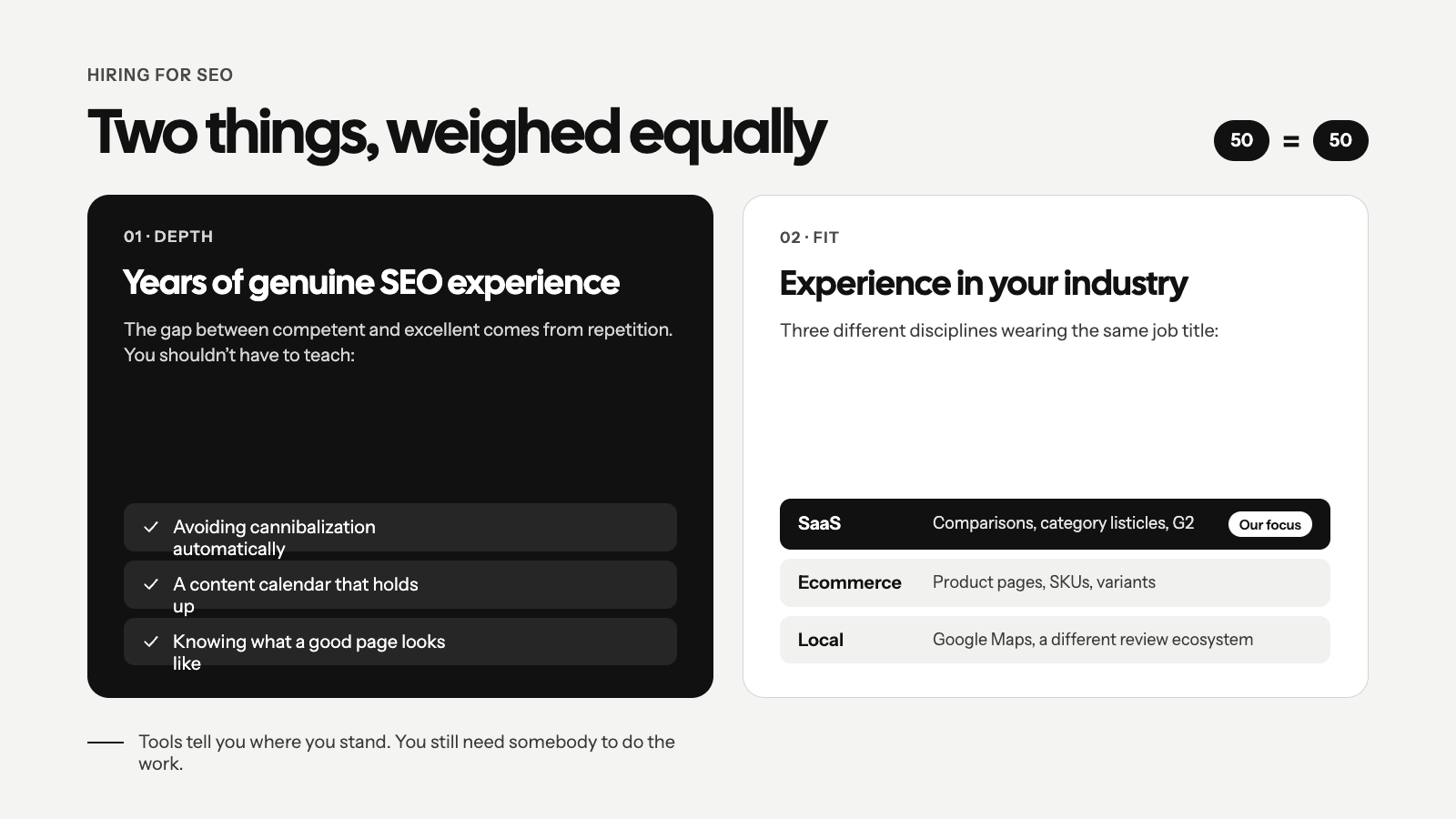
Years of genuine SEO experience:
You can get surprisingly far on the basics, but the difference between competent and excellent is large and it comes from repetition. Someone who has done this for years avoids cannibalization automatically, builds a content calendar that holds up, and knows what a good page looks like without being told. You should not have to teach any of that.
Experience in your industry:
SaaS, ecommerce and local business are three different disciplines wearing the same job title. Ecommerce means product pages, SKUs and variants. A local business means Google Maps and an entirely different review ecosystem. SaaS means comparison content, category listicles and G2. Someone excellent at one is not automatically useful at another.
We only take SaaS clients for exactly this reason, and we say no to work outside it. When a plastic surgeon asked us to take on their practice recently, the honest answer was that we could do something, and that somebody who works in medical practices every day would do it better. We would rather do one thing properly than be adequate at four.
On tooling, we use Peec for AI visibility tracking. It will tell you where you stand and what to act on, which is a reasonable place for a team to start. You still need somebody to do the work.
Frequently asked questions
How can I see which sources an AI assistant is using?
In ChatGPT, open the More actions menu on an answer and select View sources. This shows the pages the answer is drawing from and gives you a starting point for understanding why certain brands are appearing in the recommendation.
Does getting mentioned on other websites really matter for AI search?
Yes. AI assistants pull information from across the web, so your own website is only part of the picture. Comparison pages, reviews, directories, industry publications, YouTube videos and other third-party content can all contribute to how a company is represented.
Should I focus on informational content for AI search?
For commercial visibility, we’ve had better results focusing on searches where someone is already comparing products or looking for a recommendation. That includes comparison pages, alternatives and specific “best” searches tied to an industry or use case.
Can AI-assisted content work for SEO and AEO?
Yes. We use AI throughout the content process, including research, outlining, drafting and editing. The important work happens around that process: deciding what deserves a page, avoiding overlapping topics, linking content properly and having someone review the finished article.
How should I measure AI search?
Track the things you already care about: traffic, signups, demos and revenue. At the same time, keep an eye on how often your brand appears in the searches that matter to you and which sources are appearing behind those answers. AI attribution will never capture the full journey, so the two sets of data need to be looked at together.